Grammarly: how a company with Ukrainian founders became a global copywriting service
Three Ukrainian developers launched Grammarly in 2009. For eight years the company grew without venture money, and in 2025 it reported more than $700M in annual revenue. We trace the path from a paid editor for students to a freemium model and what a Ukrainian founder can take from it.
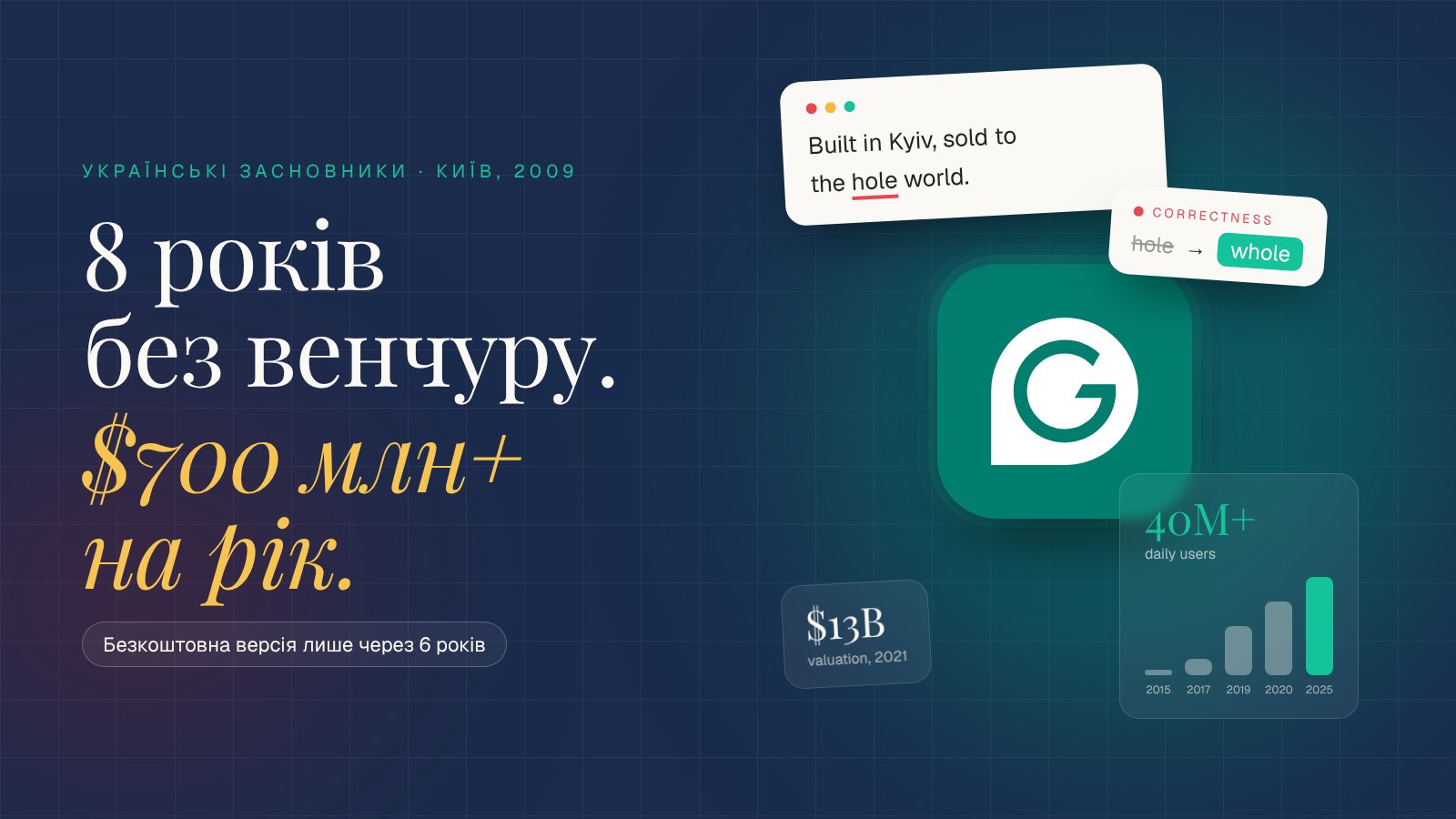
8 years
to the first venture round
40M+
people use it daily (2025)
$700M+
annual revenue, company data (2025)
01 · Overview
A product from Kyiv that millions write with
Grammarly checks English texts: grammar, spelling, style and tone. It works in the browser, email, documents and messengers. The basic check is free, and users pay a subscription for deeper suggestions.
The company was founded in 2009 by Max Lytvyn, Alex Shevchenko and Dmytro Lider. CNBC describes them as three Ukrainian software developers and says the first headquarters was in Kyiv. The head office is now in San Francisco, and the Kyiv office still operates.
- Founders
- Max Lytvyn, Alex Shevchenko, Dmytro Lider
- Year and city
- 2009, Kyiv
- Model
- Freemium: a free basic version and a paid subscription, with a separate plan for companies
- Scale
- More than 40M people daily and 50 000 organizations (company data, May 2025)
Fun fact
The founders sold their first business before Grammarly
Lytvyn and Shevchenko first built MyDropBox, a service that checked student papers for plagiarism. Dmytro Lider worked for them as a developer. In 2008 MyDropBox was sold to the education company Blackboard for an undisclosed sum. A year later the same people started Grammarly and once again began with students.
02 · Path
From a paid editor to a $13B company
Grammarly did not start with millions from investors. For the first eight years the company lived on customers' money, and only then raised venture capital.
- 2009Starting on their own moneyThe first product: an online editor for students on a paid subscription. To use it you had to enter card details. The founders told CNBC that their starting savings were under $1M and that revenue came from day one.
- 2011300 000 paid subscribersOnly then did the founders start paying themselves a salary. That same year Brad Hoover became the company's CEO. According to EdSurge, Grammarly has been profitable since 2011.
- 2015A free extension and freemiumGrammarly released a free browser extension and switched to freemium. According to the company, user growth then «took off»: that year it had 1M daily users.
- 2017First venture round: $110MGeneral Catalyst, IVP and Spark Capital invested in an already profitable eight-year-old company. At that point 6,9M people used it daily, most of them for free.
- 2019$90M and «unicorn» statusA new round from General Catalyst and IVP. The company reported 20M daily users and more than 2 000 businesses and educational institutions among its customers.
- 2021$200M at a $13B valuationNew investors included Baillie Gifford and funds managed by BlackRock.
- 2025$1B without selling equity, and a new nameIn May General Catalyst provided $1B, which the company repays with a share of revenue. After buying Coda and the email client Superhuman, in October 2025 the company renamed itself Superhuman, and Grammarly became one of its products.
8 years
from its founding in 2009 to the first venture round in 2017
$13B
the company's last announced valuation (2021)
03 · Model
Paid first, free later
Most startups do the opposite: they give the product away for free and then look for something to charge for. Grammarly sold only a paid subscription for six years and switched to freemium once it was already profitable. The free version became an acquisition channel: a person installs the extension, sees corrections in every email, and some users move to the paid plan.
How many people use Grammarly daily
Company data from different years, as reported by Grammarly, TechCrunch and Axios.
Three revenue tiers
How many people use the free version, what share of them pays and how much the subscription costs. You set the paying share: this is not Grammarly data.
Paying customers
300
Monthly revenue
59 700 UAH
Calculated before taxes and payment provider fees. Free users also cost money for servers, so count your costs too.
04 · Lessons
What made Grammarly big
- 01A familiar audience. The founders were already selling plagiarism checks to universities and knew students. Grammarly started with the same customer.
- 02Money from day one. The first product was paid, and by 2011 the company had 300 000 subscribers.
- 03The free version as a sales channel. Freemium only appeared in 2015, when the paid model was already working, and over five years daily users grew from 1M to 30M.
- 04The product where people write. The browser extension shows corrections right in email and documents, so users see the value every day.
- 05Investors come to a profitable company. The company raised its first round in 2017 while already making money.
Ukraine
A company with Ukrainian roots during the war
After the full-scale invasion in 2022, Grammarly stopped all business in Russia and Belarus. The company also kept paying salaries to Ukrainian employees who joined the army.
05 · Your startup
What to take from Grammarly's model for your startup
Not every part of Grammarly's model will suit your product. Below are six of its elements: how each worked at Grammarly, when it is worth adopting and what to consider in the Ukrainian market.
A paid first version
The free version as an acquisition channel
The product where people already work
A plan for organizations
An audience you know
Growing without an investor until there is revenue
3 risks
- 01A long road. Grammarly took 8 years to reach its first venture round, and the founders said the business came close to going broke several times.
- 02Free users cost money. You pay for the servers and AI requests, so open a free plan once paying customers cover the costs.
- 03AI is changing the market. In 2025 TechCrunch, citing an anonymous investor, wrote that Grammarly's current valuation is significantly lower than $13B in 2021. The company itself responded by buying Coda and Superhuman.
06 · Verdict
Why does Grammarly's story matter to a Ukrainian founder?
A product created by Ukrainians in Kyiv can become global. Grammarly got there through paying customers, not investors' money.
The founders started with an audience they knew, took money from day one and opened a free version only when the business was already profitable. This order works for a founder with a small budget too.
Where to start: write down which of your acquaintances or former customers already pay for a similar problem, and offer them a paid first version.
Sources
All pages opened on 26.11.2026. User numbers and revenue are reported by the company itself; there is no independent audit.
- Grammarly, Max Lytvyn on the company's 12 years, April 2021, updated November 2022
- CNBC (NBC Los Angeles reprint), interview with the founders, January 2025
- IVP, How Grammarly got to 30 million daily active users, October 2021
- TechCrunch, Grammarly raises $110 million, May 2017
- Axios, Grammarly raises $90 million, October 2019
- EdSurge, Grammarly’s second fundraise secures $90 million, October 2019
- Business Wire, Grammarly Announces $1 Billion Growth Financing, May 2025
- TechCrunch, Grammarly secures $1B in nondilutive funding, May 2025
- Grammarly, Grammarly to Acquire Superhuman, July 2025
- Grammarly, About
- Wikipedia, Grammarly
- The Kyiv Independent, 10 global companies with Ukrainian roots, August 2025
Enjoyed the story? Let's continue on Telegram
We'll discuss how to apply freemium in your product and let you know when the next story comes out.
New articles first
Teardowns, ideas and trends in the channel right after release.
Discussion
Ask questions and share ideas with like-minded people and other entrepreneurs.
Reminders and digest
The week's highlights, so you don't miss anything.